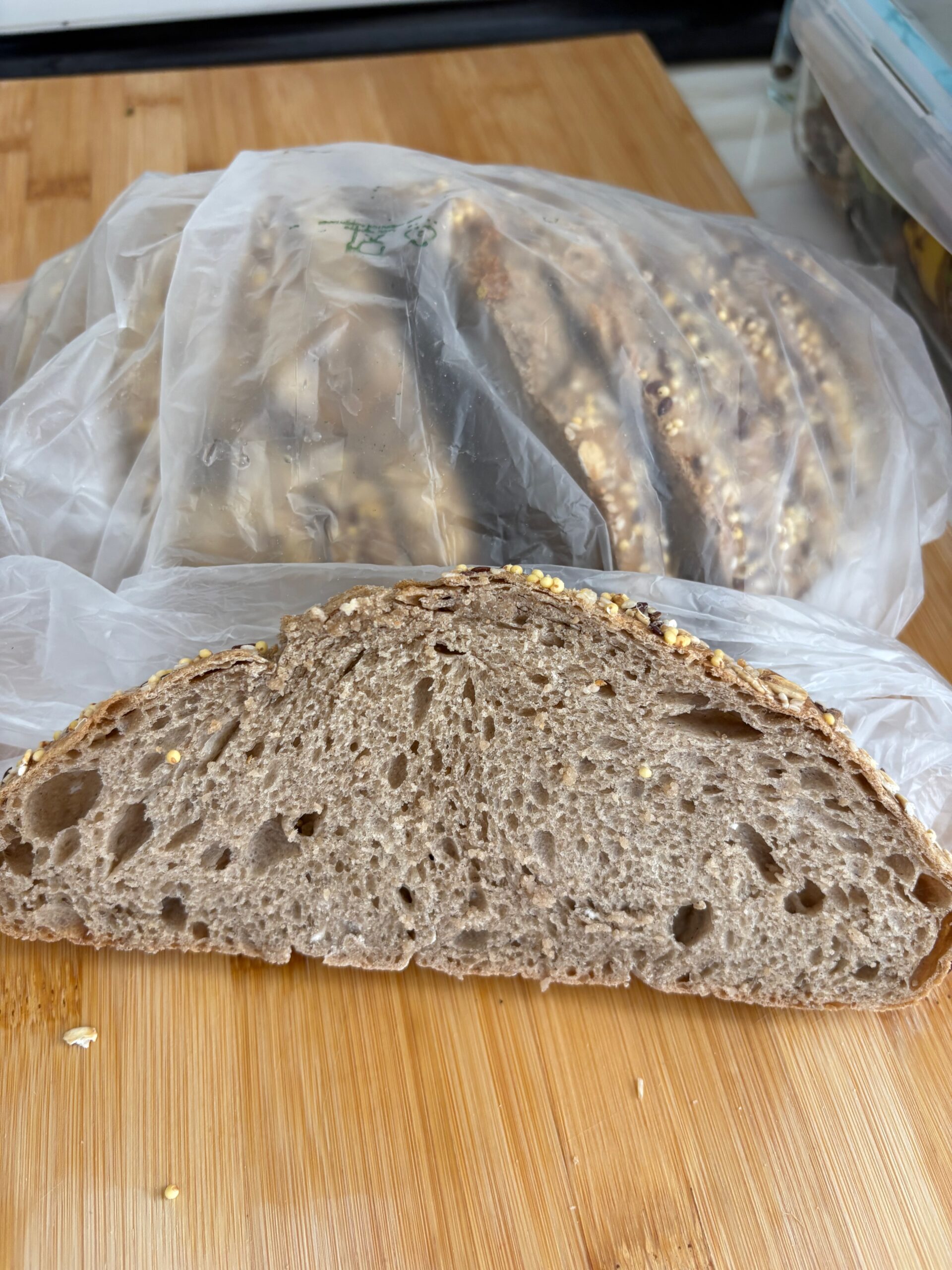
What Nobody Tells You About Eating Well Abroad
I almost got arrested buying groceries.
Not really, but it felt that way. And understanding why it happened taught me something important about what it actually takes to eat well in a new country.
I had been in Setúbal, Portugal for three days. I was shopping at the Mercado do Livramento, one of the most beautiful food markets I have ever seen, filling my backpack with things I recognized and things I was learning to recognize.
Nozes (walnuts).
Azeitonas (olives).
Ao ar livre (free-range eggs).
Tâmaras medjool (medjool dates), measured by the gram and placed in a small brown paper bag by Érica, a young Brazilian woman who noted the transaction in a Moleskine notebook and sells everything I used to buy at my co-op back home, measured by the gram and placed in brown paper bags. She is the person at this market that seems to know everything and patiently answers my questions.
The Broccoli In My Backpack
My backpack was so full the broccoli stuck out gorgeously on top.
I walked next door to Pingo Doce (Sweet Drop) the supermarket, to pick up a few more things. When I got to the checkout, a woman approached me from behind and pushed my backpack.
The cashier began speaking rapidly in Portuguese. I kept saying I didn’t understand. She kept going.
The Tall Stranger
A tall stranger came to my rescue from somewhere in the back of the line that was suddenly becoming very long. Speaking in English she told me, “They see that broccoli in your backpack and want you to pay for it.”
I pointed to the market and said that I bought it there.
“Do you have a receipt?” No, I didn’t have receipts. Most of the vendors only take cash and don’t give receipts.
In my panic I thought that I should show them the onions still covered with dirt from when they were pulled from the ground. That might prove my innocence.
The tall stranger began talking to the cashier. Back and forth, looking at the market and looking back at me. Finally, the stranger said, “She says there is a security protocol at the entrance (show your bags before you enter) and a sign explaining it.”
The Sign
As I left the store I looked for the sign. There was a sign by the door. In Portuguese. I don’t know what it said.
The cashier wasn’t angry. She wasn’t yelling. She was speaking at normal speed in a language I didn’t understand, and my frightened nervous system heard threat.
Somehow, across the language gap, it landed. The cashier had stopped. I put my hands to my heart, looked her straight in the eyes and said my most sincere obrigada (thank you). I left. I went home, went to bed, and slept for hours.
That evening I called Ana, my landlord. She laughed warmly and said: “If you get sent to jail, just call me.” Today I can laugh too. That day I could not.
What I Didn’t Understand Yet Was Brain Strain
Reading food labels in a language you’re learning is not like reading in your native language. Every word requires a small act of translation, look, recognize or not recognize, reach for Google Translate, decode, decide, move on. Multiply that by an entire market. Multiply that by three days of constant linguistic effort in every interaction, ordering food, buying groceries, reading signs, navigating buses.
By the time I walked into Pingo Doce, my cognitive load was already at capacity. There was nothing left for one more unfamiliar sign.
This is something nobody tells you about eating well abroad. The food itself may be extraordinary, and in Portugal it is. But getting to it requires mental energy that depletes faster than you expect, especially in the beginning.
Reading Food Labels in Portuguese
The word that matters most is integral. It means whole grain. But integral alone doesn’t mean 100% whole grain. A bread can contain some whole grain and still be labeled integral.
What you want is 100% integral. That phrase means exactly what it says.
The next thing to look for is the first ingredient. In Portugal as in the US, ingredients are listed in order of quantity. If the first ingredient is farinha de trigo (wheat flour), without the word integral after it, the primary flour is refined, regardless of what else is in the bread.
If the first ingredient is farinha de trigo integral (whole wheat flour) or farinha de centeio integral (whole rye flour), you have found your bread.
The bread I had been eating, Pão Mediterrâneo from Pingo Doce, is a good bread by American supermarket standards. Real ingredients, multiple grains, seeds, no high fructose corn syrup. But its first ingredient is farinha de trigo at 44%. Not whole grain.
I found this out by photographing the label and asking Claude, Anthropic’s AI, to translate it. I have been using Claude as both a thinking partner and a translation tool throughout this trip, and throughout the planning that brought me here.
The Better Answer Is the Market
The morning after I sorted out the label situation, I went back to Érica and asked her to point me toward bakers who make 100% whole grain bread. She knows the venders. She will know.
She did. That is how you find real food in a new place. Not by reading every label perfectly on day three. By building relationships with the people who know.
The brain strain eases. The language comes. The relationships form faster than you expect.
And if you get sent to jail, call Ana. She will help you.
A Few Things Worth Knowing Before You Go
If you are planning to relocate abroad or spend significant time in another country, here is what I wish someone had told me about food and cognitive load:
Give yourself grace in the first week. Your brain is working harder than you know. Every sign, every menu, every label, every transaction is a small act of translation. Rest when you need to. The market will still be there tomorrow.
Start with what you recognize. Eggs, olive oil, fresh vegetables, fruit, these are universal and easy to identify anywhere. Build from there.
Learn three words before you go. In Portugal: integral (whole grain), azeite (olive oil), biológico (organic). Three words open a lot of doors to healthy food.
Find your Érica. Every market has someone who knows everything. Find that person in the first week and build a relationship. They will teach you more than any label.
Photograph everything you can’t read. Google Translate’s camera function translates labels in real time. Claude can translate and explain ingredients in depth. These tools exist. Use them without embarrassment.
It Takes a Few Days, Give Yourself a Little Grace
The food here is extraordinary. Real food, straight off every menu, without modification. A culture where taking care of yourself is built into the landscape.
It just takes a few days — and a little grace for your brain — to find your way into it.
Even if you never leave home, give yourself a little grace as you begin taking steps toward changing the way you eat. Your brain is working harder than you know. Rest when you need to.
We are in this together,
🌀 Nora
This post is part of a series of essays written from Setúbal, Portugal and was written on May 23, 2026. Read our other posts in The Portugal Series.
About This Post
This post is about Nourish, one of the four Pillars of Small Steps Lasting Change. It also looks at how two of The Patterns, Identifying Supports and Drifting did more of the real work than perfect label reading ever could: finding someone at the market who already knows the answers, and giving yourself grace when the mental effort of a new language runs out before the day does. Learn more about Nourish and The Patterns.
Read more of our posts about Nourish and The Patterns.
About Small Steps Lasting Change
Small Steps Lasting Change is a wellness practice for people living with chronic illness and changing capacity. It is built around four Pillars (Move, Nourish, Rest, and Protect) and six Patterns for navigating change as it actually happens in a human life.
Begin where you are.
Nora Chaus is the founder of Small Steps Lasting Change. She is a retired registered nurse, a facilitator, and a work in progress. She divides her time between Portugal, Canada, and Baltimore.